Pole Sport: how to fill your DS
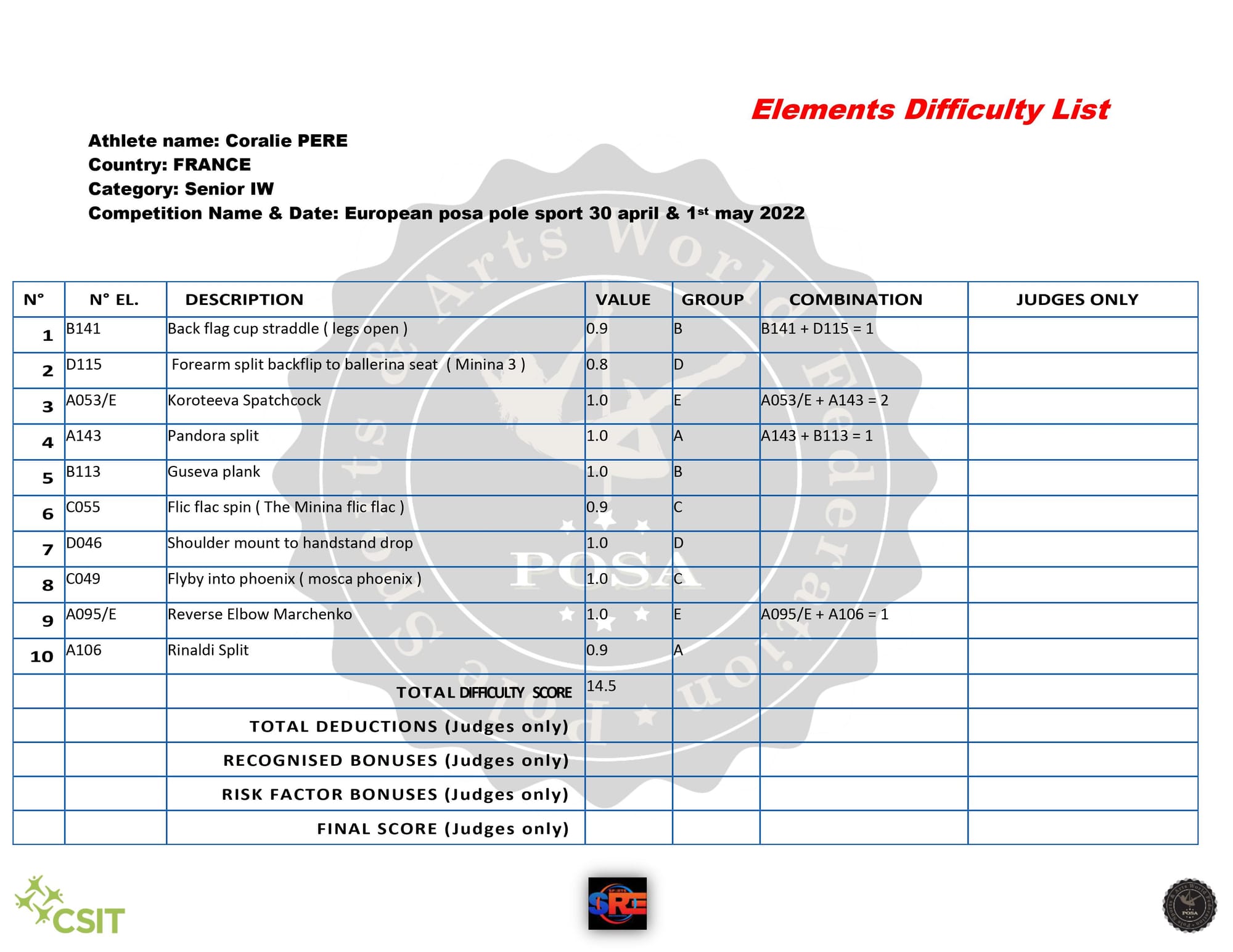
How do I properly fill out my difficulty sheet?
1/ How many figures do I need to declare?
An amateur must declare 5-6 elements in duo or solo (the 6th element is not mandatory), an elite must declare 10 solo figures and 5 in duo.
A parapole does not declare any element.
2/ The 10 figures in the 5 "families" of elements:
In your difficulty sheet (which we will call DS after this) you must write 10 figures (not one more), AND you must not include your acrobatics (see below "the bonuses").
We suggest you choose 2 figures per family of elements, namely:
– 2 Flexibility figures (A)
– 2 Force figures (B)
– 2 Static Spin figures (C)
– 2 Dynamic figures (D)
– 2 Spinning figures (E) → perform two complete rotations, to be chosen from family A or B (Note: if you do not complete two rotations, it will not be validated)
A total of 10 elements must be entered on your DS (Diagnostic System), ideally 2 from each category. Otherwise, you may be penalized 3 points. Of course, it's possible to include 3 flexibility elements and one strength element, for example, but it's best to be sure of your choices. Because if your strength element isn't accepted, you'll receive a 2-point penalty because you'll have lost category B. For two categories lost: 4 points deducted, and so on…
The trick must meet the minimum requirements to be validated; otherwise, you will receive a downgrade of -0.2 or -0.4 points (for example, for planks or flexibility tricks), or if you are not on the correct axis. The trick may not be validated if you are at a bad angle. The judge will consider the trick valid if they can see all the prerequisites for that trick. For example: I land my Russian split at a bad angle, my foot is pointing towards the back of the stage. The judge, who is facing the stage, will not see if your back leg is parallel to the ground. Therefore, your trick will not be validated even if you performed it.
3/ Where should my figures be located? What level of difficulty?
Points range from 0.1 to a maximum of 1, but not all categories have the opportunity to use all the figures.
° Junior A: AMATEUR between 0.1 and 0.4 (a 6th element possible at 0.5 or more) COMPETITIVE between 0.1 and 0.7 (and one element possible above 0.7)
° Junior B: AMATEUR between 0.1 and 0.5 (a 6th figure possible at 0.6 or more) COMPETITIVE between 0.2 and 0.9 (and one possible element above 0.9)
° Senior: AMATEUR between 0.1 and 0.5 (and a 6th figure possible at 0.6 or more) COMPETITIVE between 0.3 and 1.
° Master 40: AMATEUR between 0.1 and 0.5 (and one possible element at 0.6 or more) COMPETITIVE between 0.2 and 0.7.
° Master 50: AMATEUR between 0.1 and 0.4 (and one possible element at 0.6 or more) COMPETITIVE between 0.2 and 1.
4/ The Bonuses
The ADB and CBRF are ONLY for Senior Women, Senior Men, Senior double, Master 40 and 50+.
• The risk-taking bonus: can only be awarded a maximum of two times, and it's not up to you to score it, but the judges. If it's noted, you risk a 3-point penalty. For these bonuses to be valid, certain moves must be performed at least 70% of the pole. Any element marked CBRF can help you choose one of these "Risk Factor" moves.
• Super bonus or ADB: you can have 1 combination bonus in ADB.
For your combination to be valid, it must be a direct combination and not two figures from the same family but worth 1 point each. If the minimum requirement is met, you will receive 2 points.
There is no description to add, it should be entered like a computer code (for example: A053/E+A143=2)
If the minimum required has not been met for one of the two figures then the ADB bonus will